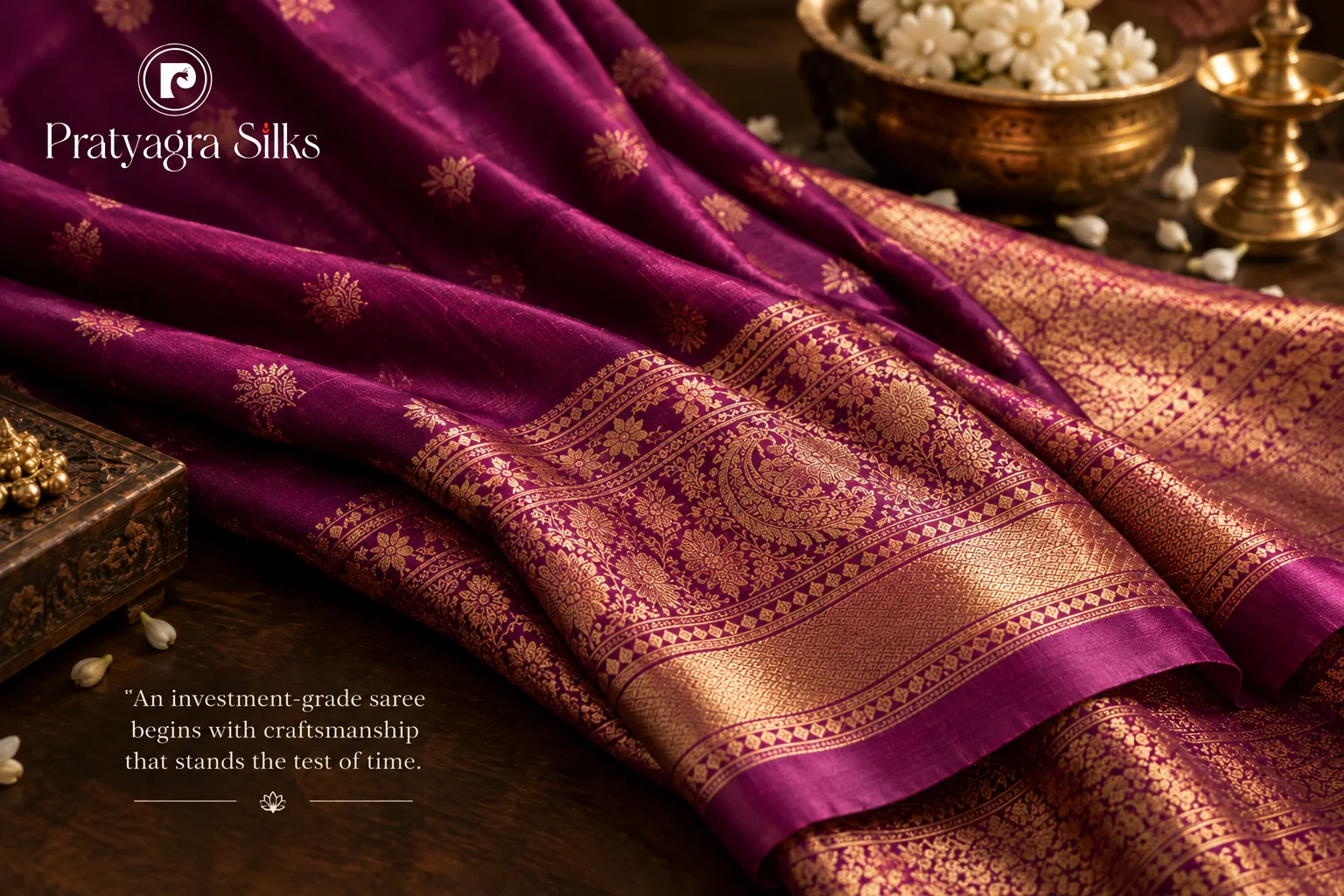
Why Some Sarees Become More Than Just Occasion Wear
Not every saree is chosen simply for the next celebration.
Some sarees are purchased with the intention of keeping them for years, wearing them across generations, and eventually passing them down as part of a family’s story.
That is what we mean when we talk about an “investment-grade” saree.
It is not simply about a high price.
For Pratyagra Silks, a saree earns that consideration through the quality of its silk, the skill behind its weaving, the authenticity of its materials, the precision of its zari work, and the care taken throughout its creation.
A beautiful saree may catch your eye.
A well-made saree gives you reasons to keep it.
Our quality philosophy begins with that difference.
What Does "Investment-Grade" Really Mean?
It Is About Quality, Not Just Price
An expensive saree is not automatically an investment-grade saree.
Price can reflect many things, but quality comes from what is actually present in the saree.
We look beyond the price tag to understand the craftsmanship, materials, weaving process, detailing, and finishing.
For us, investment-grade means choosing a saree with qualities that can continue to matter long after the occasion for which it was purchased.
The Craftsmanship Should Be Visible
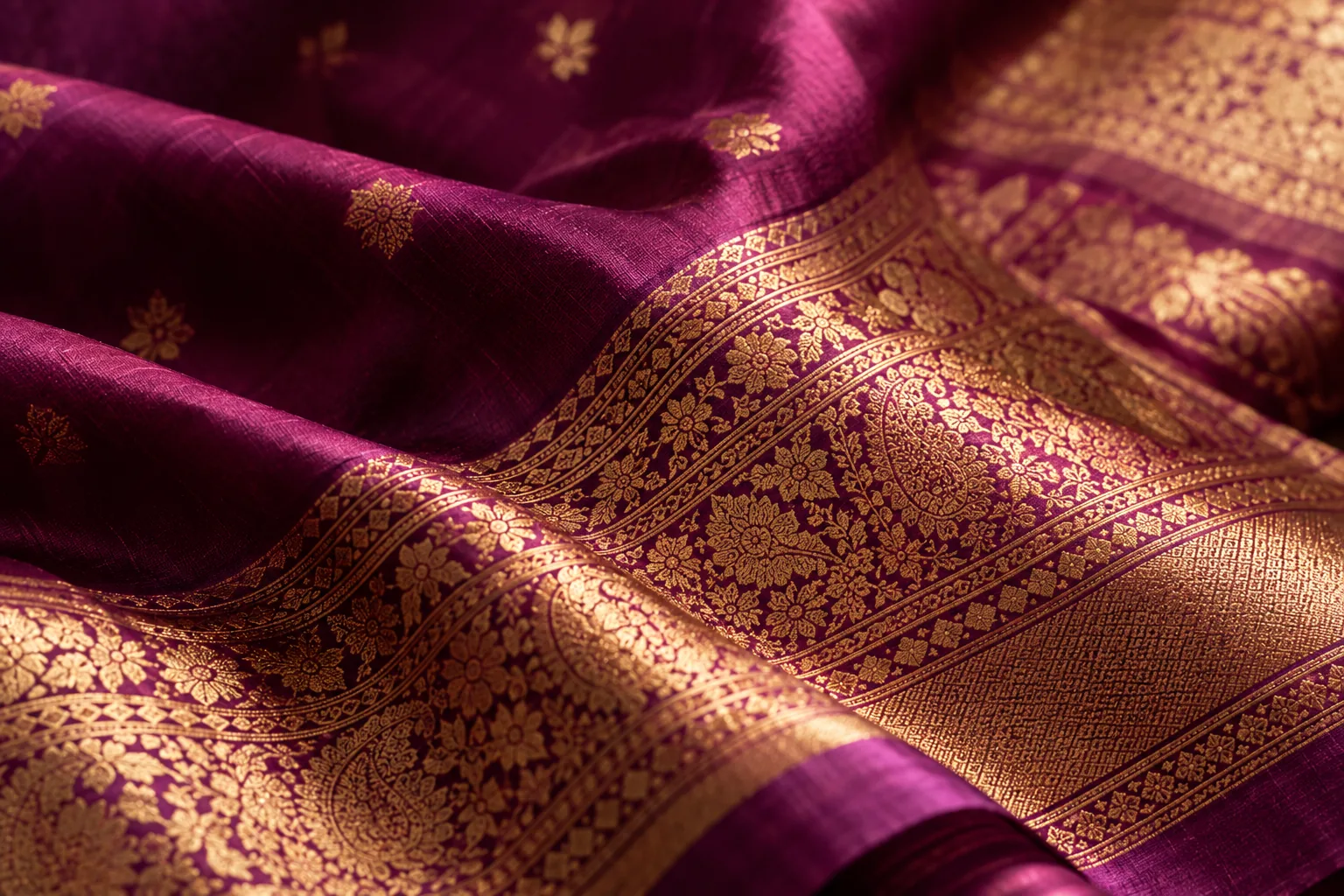
Handwoven craftsmanship has details that reward closer attention.
The consistency of the weave, the precision of the motifs, the alignment of the border, the finishing of the pallu, and the quality of the zari all contribute to the character of a saree.
These are not details that should disappear once the saree is worn.
They are part of what makes the piece special.
Longevity Is Part of the Philosophy
A saree intended to become part of a wardrobe for years needs to be made with materials and craftsmanship that support that purpose.
We therefore consider how a saree is constructed rather than judging it only by its appearance when new.
For us, quality is something that should remain meaningful beyond the first wear.
Five Elements We Look For in a Quality Saree
The Quality of the Silk
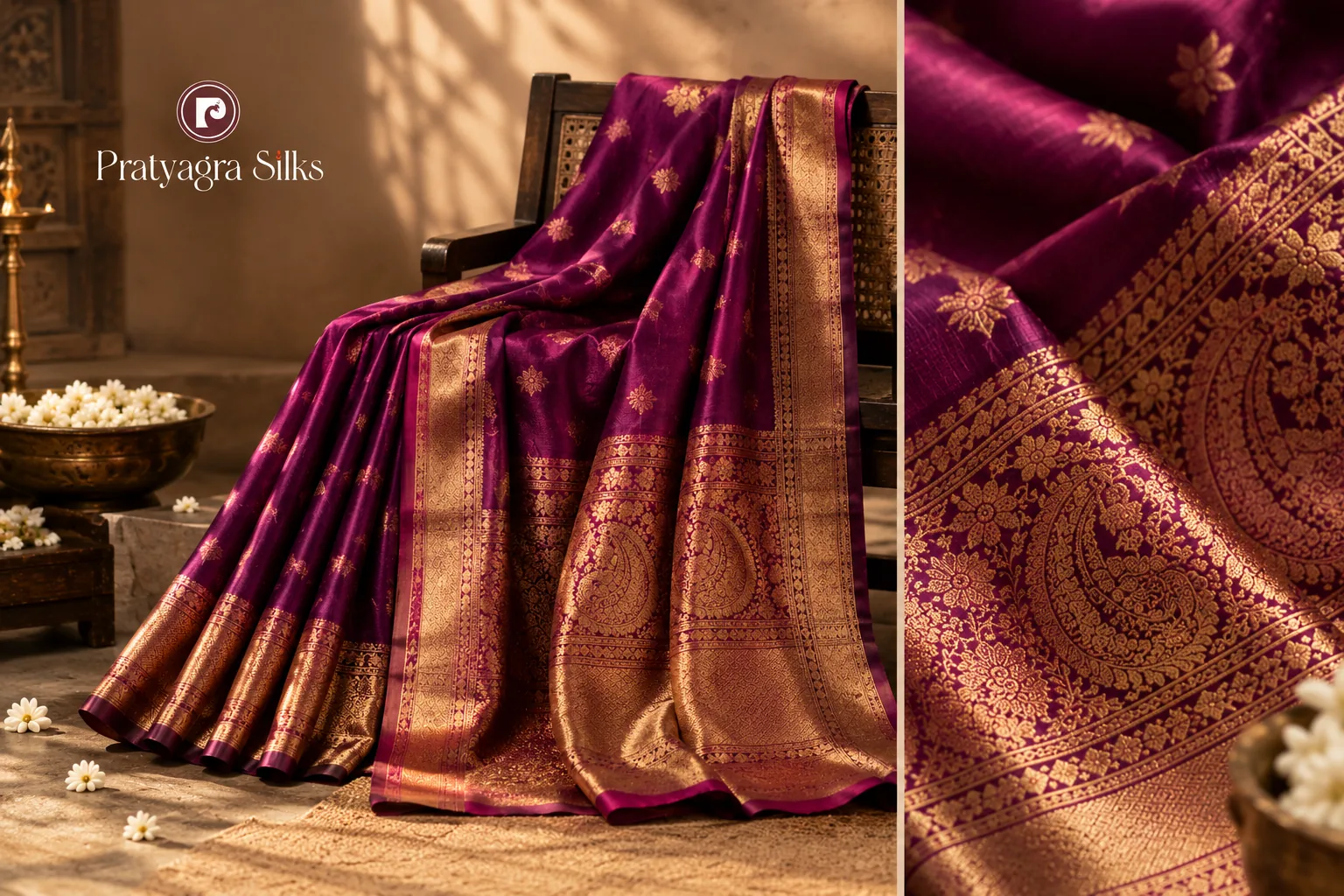
Silk is the foundation of a silk saree.
We prioritize pure mulberry silk where the tradition calls for it and pay attention to the quality and consistency of the silk used.
The way silk feels, falls, reflects light, and responds to weaving all contribute to the finished saree.
A quality silk saree should feel considered from the very beginning of its construction.
The Precision of the Weave
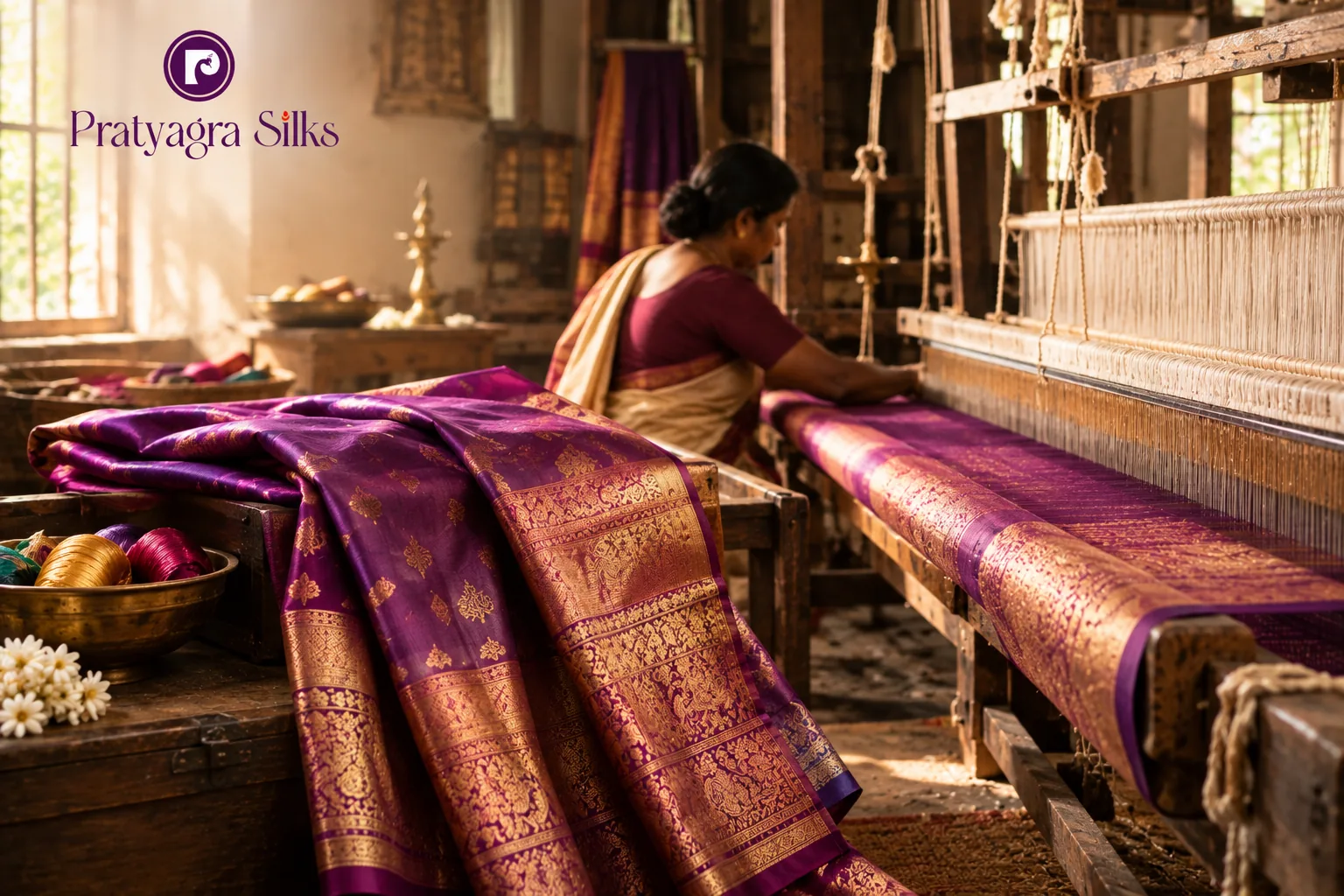
A handwoven saree carries the work of the weaver in every section.
We look at weave density, consistency, and the way the design has been executed.
Traditional techniques require patience and skill, and shortcuts taken during weaving can affect the final appearance and finish.
For us, precision matters because the beauty of a saree should come from the quality of the work rather than simply from its design.
The Quality of the Zari
Zari is one of the most visually distinctive elements of many traditional silk sarees.
We pay attention to its consistency, detailing, and how it has been incorporated into the weave.
Good zari work should complement the silk rather than overpower it.
The relationship between the silk, zari, border, and motifs is part of what gives a saree its character.
The Finishing
A saree can have beautiful materials and still fall short if the finishing is not carefully handled.
We look at the overall finish, the consistency of the weaving, the detailing, and the way different elements come together.
The final inspection matters because small details can make a significant difference to the finished piece.
The Authenticity of the Craft
For us, quality also means respecting where a saree comes from.
A Kanjivaram from Kanchipuram, a Banarasi from Varanasi, or another regional handloom tradition carries techniques and design language shaped by generations of artisans.
We believe those characteristics should be preserved rather than simplified simply to make production faster.
What We Check Before a Saree Joins Our Collection
We Look Beyond the First Impression
A saree can look impressive in a photograph.
Our evaluation goes further.
We examine the weave, materials, zari work, detailing, finishing, and overall craftsmanship before considering a saree for the collection.
The objective is not simply to find something beautiful.
It is to find something that meets our standards.
We Pay Attention to the Details
Quality often reveals itself in places that are easy to overlook.
The consistency of the weave. The precision of the motifs. The way the border meets the body. The detailing of the pallu. The finish of the fabric.
These individual elements come together to determine how complete the saree feels.
We Do Not Rush the Process
Handloom craftsmanship has its own timeline.
Depending on the design and complexity, a handwoven saree may take several days or weeks to complete.
We respect that process rather than treating speed as the primary measure of efficiency.
Some things are worth taking the time to get right.
Why Quality Matters More Than Trends
Trends Change. Craftsmanship Remains.
Fashion trends can change from one season to another.
Traditional craftsmanship has a much longer history.
A saree made with authentic materials and strong craftsmanship does not depend entirely on a passing trend to have value.
That is why our quality philosophy begins with the craft rather than the trend.
A Saree Can Become Part of a Family Story
One of the reasons people choose premium handwoven sarees is their ability to remain meaningful beyond a single occasion.
A saree may be worn for a wedding today, carefully stored, and worn again years later for another important family celebration.
Eventually, it may become something a daughter or granddaughter chooses to wear.
That possibility is part of what makes quality matter.
Investment Does Not Always Mean Financial Return
When we use the word “investment,” we are not promising that a saree will increase in monetary value or become a financial asset.
We use the term to describe a considered purchase—one chosen for craftsmanship, authenticity, longevity, and the possibility of becoming a lasting part of your wardrobe or family.
The real value can be in how long the saree remains meaningful.
Our Quality Philosophy
At Pratyagra Silks, quality is not one feature added at the end of the process.
It begins with the choice of weaver and materials and continues through weaving, detailing, finishing, and inspection.
We prioritize craftsmanship over shortcuts.
We look for authentic materials rather than substitutes that simply imitate appearance.
And we are willing to reject a saree when it does not meet the standard we expect, even when it looks impressive at first glance.
For us, an investment-grade saree is not defined by a number on a price tag.
It is defined by the work behind it.
The silk. The weave. The zari. The finishing. The tradition.
And the hands that brought everything together.
Q&A
What Does "Investment-Grade" Mean for a Saree?
For Pratyagra Silks, it describes a saree selected for its craftsmanship, authentic materials, quality of weaving, finishing, and long-term significance rather than price alone.
Does an Expensive Saree Automatically Mean It Is Investment-Grade?
No. Price alone does not determine quality. The materials, craftsmanship, weaving technique, zari, finishing, and authenticity all matter.
What Should I Look for in a High-Quality Silk Saree?
Look at the quality of the silk, consistency of the weave, precision of the motifs, zari work, finishing, and the authenticity of the weaving tradition.
Why Is the Weaving Process Important?
Handwoven craftsmanship requires time and skill. The weaving process influences the texture, consistency, detailing, and overall character of the finished saree.
Does Investment-Grade Mean the Saree Will Increase in Value?
Not necessarily. Pratyagra does not define "investment-grade" as a promise of financial appreciation. It refers to a considered purchase based on craftsmanship, quality, authenticity, and long-term significance.
Why Does Pratyagra Focus So Much on Craftsmanship?
Because craftsmanship is what gives a handwoven saree its character. The materials may be beautiful, but the skill and time invested by the weaver are what bring them together into a finished piece.
How Does Pratyagra Maintain Its Quality Standards?
We evaluate sarees based on craftsmanship, materials, weaving consistency, zari work, finishing, and authenticity before they become part of our collection. We are willing to say no when a saree does not meet our standards.
Explore sarees chosen for craftsmanship built to last for generations.
Comments